HER MOTHER SAID SHE WASN’T FAMILY—THEN MARLO ASKED ONE QUESTION
CHAPTER 3 — WHAT THE HOUSE WAS NEVER WORTH
No one spoke for several seconds.
Outside, the violinist began testing a few quiet notes.
The ceremony was approaching.
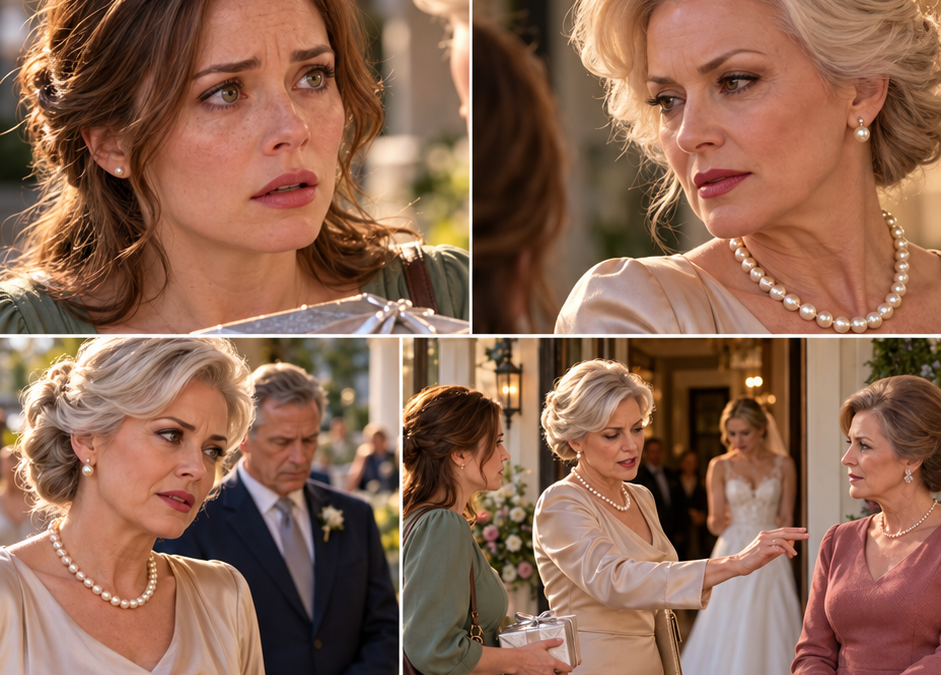
Inside the doorway, Sable stood holding the brass key and their grandmother’s letter.
Her wedding dress caught the sunlight coming through the entrance.
Marlo watched her younger sister read the last sentence again.
A house is not a family.
Do not ever confuse the two.
Sable folded the note carefully.
Then she looked at Elo.
“Why?”
Elo’s eyes lifted.
Sable’s voice trembled.
“Why did you need Marlo gone?”
“I never wanted her gone.”
Marlo said nothing.
Sable looked toward the blue folder.
“You told me she didn’t care.”
“I told you what I believed.”
“You hid her emails.”
Elo’s jaw tightened.
“I filtered things when emotions were high.”
“You lied.”
Elo’s composure cracked.
“I was trying to keep this family together.”
Sable shook her head.
“You kept us apart.”
Their father sat slowly on the wooden bench outside the doorway.
His shoulders seemed to have aged ten years.
Elo looked toward him.
He did not rescue her.
For once, no one did.
Marlo stood quietly beside Sable.
She had spent years imagining what it would feel like to finally confront her mother.
She had thought it would feel triumphant.
It did not.
Mostly it felt sad.
Elo looked at Larkspur House.
At the white columns.
At the roses.
At the expensive details she had spent decades perfecting.
“When I married your father,” she began, “I had nothing.”
Neither daughter interrupted.
“His mother never thought I belonged here.”
Marlo’s expression changed slightly.
Elo continued.
“She corrected the way I set the table.”
A humorless smile touched her mouth.
“The way I pronounced names. The clothes I wore. The flowers I chose.”
Her hand moved instinctively toward the pearls around her neck.
“She made certain I understood that I had married into something I could never truly own.”
Marlo watched her.
For the first time she was hearing the origin of the obsession instead of merely suffering its consequences.
“So I learned.”
Elo looked toward the gardens.
“I learned every tradition.”
“The right people.”
“The right charities.”
“The right weddings.”
“The right stories about the family.”
She inhaled slowly.
“And eventually everyone looked at Larkspur House and saw me.”
Marlo understood.
That was the problem.
Elo had not merely lived in Larkspur.
She had used it to construct herself.
“When the financial problems started,” Elo said, “I thought I had failed.”
Her father looked toward her.
“You never told me that.”
Elo almost laughed.
“You were terrified too.”
He had no answer.
Elo looked at Marlo.
“Then you came home.”
Marlo waited.
“You opened those boxes of paperwork.”
Her mother’s voice softened.
“You started calling people.”
A pause.
“And suddenly everyone listened to you.”
Marlo felt something tighten behind her ribs.
“You were my daughter.”
Elo swallowed.
“And I was proud of you.”
Marlo blinked.
“Then why—”
“Because I was also ashamed.”
The honesty silenced her.
“You were twenty-seven and fixing things I had spent thirty years pretending were fine.”
Elo’s eyes glistened.
“Your father started asking what you thought.”
“The attorneys asked for Marlo.”
“The accountants asked for Marlo.”
“Every contract came back with your name.”
She looked toward the house.
“And every time I saw it, I felt like another piece of my life belonged to you.”
Marlo shook her head.
“I never wanted your life.”
“I know.”
The answer came immediately.
That hurt more.
Elo continued.
“I knew you didn’t want to take Larkspur.”
“Then why punish me?”
Her mother looked at her.
“Because if you weren’t trying to take it, then I had to admit you deserved the authority.”
There it was.
Ugly.
Human.
Small.
Marlo looked away.
Elo had tried to erase her daughter because gratitude felt too much like surrender.
Sable sat beside their father.
The brass key remained in her hand.
Elo looked toward her.
“When the Whitmirs entered the picture, I thought I could finally secure everything.”
Odessa, still standing nearby, raised her eyes.
Elo glanced toward her.
“A strong family.”
“Resources.”
“Connections.”
“I thought if Larkspur became part of Sable’s future, it would never be vulnerable again.”
Marlo frowned.
Odessa stepped forward.
Until then, she had said nothing.
Now she held up one hand.
Then reached into her handbag.
She removed a second envelope.
Marlo recognized the stationery.
The Whitmir family.
Odessa handed it to Sable.
Sable opened it.
Her eyes moved quickly.
Then stopped.
“What?”
Marlo leaned closer.
The letter was dated almost a month before the wedding.
It was addressed to Elo.
Thank you for the generous discussion regarding Larkspur House. Our family has no interest in ownership, partnership, operational control or future claim to the Sinclair property.
We consider Sable’s marriage to our son a joining of people, not assets.
Please do not include the estate in any agreement made on our behalf.
Marlo slowly looked up.
Elo had gone completely still.
Sable read the paragraph again.
Then another.
Odessa’s family had explicitly declined any part of Larkspur.
Weeks ago.
“You knew,” Sable whispered.
Elo did not answer.
“Mom.”
“Yes.”
Sable stared at her.
“You knew they didn’t want the house.”
Elo closed her eyes.
Marlo suddenly understood everything.
There had never been pressure from the Whitmirs.
No demand.
No expectation.
No threat to Sable’s future.
Elo had created the transfer herself.
She had forged Marlo’s approval for a solution to a problem that did not exist.
“Why continue?” Marlo asked.
Elo opened her eyes.
Her voice was almost inaudible.
“Because by then it was no longer about them.”
Marlo waited.
“It was about getting my house back.”
Silence.
Her house.
Not Sable’s security.
Not the Whitmirs.
Not the wedding.
Control.
Marlo felt the final illusion disappear.
Elo looked toward the entrance.
“I thought if everything returned to the family after today, I could fix what had happened.”
Marlo shook her head.
“You mean erase what happened.”
Elo did not deny it.
Marlo held out her hand.
“The clutch.”
Elo looked confused.
“Give it to me.”
After a moment, Elo handed it over.
Marlo opened it.
Inside were two pens.
Lipstick.
Tissues.
And one flash drive.
Marlo held it up.
“What is this?”
Elo looked toward the ground.
“Copies.”
“Of what?”
“The transfer documents.”
Marlo’s stomach tightened.
“Anything else?”
“Drafts.”
“Emails?”
“Yes.”
Marlo placed the drive inside the blue folder.
“No more.”
Elo nodded.
Marlo looked at her father.
“Do you have copies?”
“No.”
“Access to anything?”
He shook his head.
Then paused.
“Yes.”
Marlo waited.
“My email.”
“I forwarded some documents.”
Marlo held out her hand.
Her father took out his phone.
He gave it to her.
No argument.
No hiding.
Marlo forwarded the relevant correspondence to herself and the independent attorney already assigned to Larkspur House Events.
Then she returned the phone.
“This is the last time family business gets handled without outside review.”
Her father nodded.
Elo said nothing.
Sable looked toward the garden.
The music had changed.
Guests were beginning to take their seats.
Her ceremony should already have started.
She stood.
Everyone watched her.
Sable looked at Marlo.
“I don’t know if I can do this.”
Marlo stepped closer.
“The wedding?”
Sable nodded.
“I feel like everything about today is poisoned.”
Marlo looked toward the gardens.
Then toward the key in her sister’s hand.
“No.”
Sable frowned.
“Mom’s choices are poisoned.”
Marlo touched the key.
“This isn’t.”
Sable’s eyes filled.
“Your marriage isn’t a contract she gets to define.”
Marlo continued.
“If you love him, marry him.”
“If you don’t, don’t.”
“But don’t let Mom’s mistake make that decision for you too.”
Sable stared at her.
Then gave a shaky laugh.
“You sound like a compliance analyst.”
Marlo smiled for the first time that afternoon.
“You say that like it’s not incredibly romantic.”
Sable laughed.
A real laugh.
It broke something open between them.
Then Sable hugged her.
There was no hesitation this time.
Marlo wrapped both arms around her younger sister.
Wedding fabric gathered between them.
Sable whispered into her shoulder.
“I’m sorry.”
Marlo closed her eyes.
“I know.”
“I should have called you.”
“I should have called you too.”
Sable pulled back.
“No. Don’t do that.”
Marlo frowned.
“You don’t have to split this fifty-fifty just because that makes everyone more comfortable.”
Marlo stared.
Sable wiped her cheek.
“She lied to me.”
“She lied to you.”
“I should have questioned it.”
“But she did it.”
Marlo’s throat tightened.
Sable reached for her hand.
“I believe you.”
Three words.
That was all.
But they repaired something Marlo had stopped believing could be repaired.
A wedding coordinator appeared at the far end of the hall.
She froze when she saw the family.
Sable looked at her.
“Five minutes.”
The coordinator nodded and disappeared.
Sable turned to Marlo.
“Will you stay?”
Marlo looked toward Elo.
Her mother’s face remained pale.
For years, Marlo had believed boundaries were measured by distance.
Leave the room.
Leave the house.
Leave the relationship.
Now she realized staying could also be a boundary if she stayed by choice.
“I’ll stay.”
Sable exhaled.
“But not because everything is okay.”
“I know.”
“And not because we pretend this didn’t happen.”
“I know.”
Marlo nodded.
“Then yes.”
Sable squeezed her hand.
Their father stood.
He approached Marlo.
“I owe you more than an apology.”
“Yes.”
The direct answer surprised him.
Marlo continued.
“You let Mom define me because correcting her was uncomfortable.”
He nodded.
“You let me carry responsibilities you never explained to Sable.”
Another nod.
“And today you watched her stop me outside.”
His eyes dropped.
Marlo waited.
He forced himself to lift them again.
“I did.”
“You need to understand why that matters.”
“I do.”
“No.”
Marlo shook her head.
“You’re beginning to.”
He accepted that.
Then he said something Marlo did not expect.
“I’m resigning from every position connected to Larkspur House Events.”
Marlo stared.
“You don’t need to decide that today.”
“I already did.”
He looked toward the documents.
“I signed something I didn’t read because I wanted to avoid an argument with my wife.”
His mouth tightened.
“A person who does that should not have signing authority.”
Despite everything, Marlo almost smiled.
“That may be the most responsible thing you’ve said about the company in eight years.”
He laughed once.
Then his face crumpled.
He stepped toward her.
Stopped.
He did not assume he was allowed to hug her.
Marlo noticed.
After a moment, she reached out and touched his arm.
Not forgiveness.
But not nothing.
He nodded.
Then moved away.
Elo remained near the doorway.
Marlo approached her last.
Her mother looked at the silver gift paper left on the bench.
“Will you ever forgive me?”
Marlo considered the question carefully.
“I don’t know.”
Elo’s eyes closed.
Marlo continued.
“But if you want any relationship with me, you stop asking for forgiveness before you’ve changed.”
Elo looked at her.
“No more using Dad to contact me.”
A nod.
“No more messages through Sable.”
Another nod.
“No more business access.”
“Yes.”
“No telling people why I am or am not at family events.”
“Yes.”
Marlo held her gaze.
“And no more deciding what my absence means.”
Elo swallowed.
“Yes.”
Marlo stepped back.
“Then maybe we can start there.”
The ceremony began twenty-three minutes late.
No guest ever learned why.
Sable walked down the aisle beneath the ancient oaks.
Her father accompanied her halfway.
Then, to everyone’s surprise, Sable stopped.
She looked toward the second row.
Toward Marlo.
Marlo frowned.
Sable held out her hand.
A murmur passed through the guests.
Marlo stared at her.
Sable smiled through tears.
Marlo stood.
She walked into the aisle.
Her father stepped slightly aside.
Without explanation, the three of them walked the final stretch together.
Marlo on Sable’s left.
Their father on her right.
When they reached the front, Sable squeezed Marlo’s hand before letting go.
Across the aisle, Odessa smiled.
Elo sat very still.
She was crying.
Quietly.
But she did not make the moment about herself.
That mattered.
The wedding continued.
The vows were spoken.
The guests applauded.
And Larkspur House remained standing.
Not because Elo controlled it.
Not because Marlo controlled it.
Because for the first time, the people inside it were beginning to understand that control had never been the same thing as love.
Three months later, Marlo received an envelope at work.
There was no return address.
Inside was a notarized resignation from Elo surrendering every remaining administrative role connected to Larkspur House Events.
Beneath it was a handwritten note.
No excuses.
No long defense.
Only:
I spent years protecting the house from being lost.
I never noticed I was losing my daughters.
I will not ask you to make that easier for me.
Marlo read the note twice.
Then placed it in the bottom drawer of her desk.
She did not call.
Not that day.
Change was not measured by one letter.
Six months passed.
Her father enrolled in a financial-responsibility course for family businesses.
He attended every session.
Sable called Marlo every Sunday.
Sometimes they talked for an hour.
Sometimes five minutes.
Sometimes they argued.
The important part was that nobody interpreted the argument for them afterward.
Odessa occasionally joined them for lunch.
Marlo discovered she was much funnier than her quiet wedding-day presence suggested.
Larkspur House continued operating.
Marlo kept control temporarily while a genuinely independent board structure was created.
No single Sinclair would ever again be able to use the estate as personal leverage.
The most surprising change came almost one year after the wedding.
Marlo drove to Larkspur on a Sunday afternoon.
There were no guests.
No flowers arranged for strangers.
No photographers.
Only the slow movement of oak branches over the lawn.
Elo was sitting near the rose garden.
She saw Marlo.
She stood instinctively.
Then stopped herself.
“Hello.”
Marlo approached.
“Hi.”
Elo gestured toward the bench.
“Would you like to sit?”
Marlo considered it.
Then sat.
A careful amount of space remained between them.
For several minutes, neither spoke.
Elo looked older.
Not dramatically.
Simply more human.
Her hair was less severe.
No pearls.
No champagne silk.
Just a pale blouse and garden gloves resting beside her.
“I started therapy,” Elo said.
Marlo looked at her.
“I’m not telling you because I expect credit.”
Marlo waited.
Elo smiled faintly.
“My therapist says I explain myself when I should apologize.”
“That sounds expensive but accurate.”
Elo laughed.
Marlo had forgotten what her mother’s real laugh sounded like.
It was quieter than the social one.
Elo looked toward the house.
“I kept thinking if people needed me, they would never leave me.”
Marlo listened.
“So I made myself necessary.”
A pause.
“And when you became necessary instead, I treated you like competition.”
Marlo’s eyes lowered.
Elo continued.
“You weren’t competing.”
“No.”
“I know.”
The words were simple.
This time they sounded different.
Elo placed one hand on the bench between them.
She did not reach for Marlo.
She simply left it there.
An invitation.
Nothing more.
After several seconds, Marlo placed her own hand beside it.
Their little fingers touched.
Neither woman moved closer.
It was enough.
A voice called from across the lawn.
Sable.
She was carrying a pitcher of lemonade.
Their father followed with glasses.
Marlo looked toward the old garden room.
Its door stood open.
“Did Sable unlock it?”
Elo smiled.
“She barely locks it anymore.”
The four of them walked toward it.
Inside, the room had changed only slightly.
The old table remained beneath the window.
Their grandmother’s faded curtains still moved whenever the breeze came through.
But there were now four mismatched chairs.
Marlo stopped.
Sable noticed.
“What?”
“There used to be two.”
Sable set down the lemonade.
“Well.”
She looked toward their parents.
“Family gets complicated.”
Marlo laughed.
They sat.
Nobody gave a speech.
Nobody declared the Sinclairs healed.
They were not.
Some wounds had closed.
Others were still tender.
Trust returned in inches.
Not miles.
But nobody at the table was pretending anymore.
Near sunset, Marlo noticed something mounted beside the garden-room door.
A small brass plaque.
She stood.
Walked closer.
Then read it.
Their grandmother’s words had been engraved there.
A house is not a family.
Do not ever confuse the two.
Marlo turned.
“Who did this?”
Sable smiled.
“Mom.”
Marlo looked at Elo.
Her mother lowered her eyes.
Not from shame this time.
From humility.
Marlo touched the edge of the plaque.
All those years she had believed the great victory was saving Larkspur House.
Saving the roof.
The land.
The contracts.
The Sinclair name.
Now she understood.
That had only saved property.
The harder thing was happening here.
Four people sitting inside a tiny room, learning to tell the truth without deciding first how it would look.
Outside, the evening breeze moved gently through the Alabama roses.
Larkspur House stood beyond the trees, grand and white and beautiful.
But no one inside the garden room was looking at it.
And for the first time in years, Marlo knew exactly where home was.
If you enjoyed Marlo’s story, there are many more emotional family dramas, buried secrets, unexpected betrayals, and hard-earned reconciliations waiting to be discovered.
You Might Also Enjoy
SHE TOLD HIS MOTHER THE MANSION WASN’T HERS—THEN SECURITY BROUGHT OUT THE TABLET CHAPTER 2 — THE $1.85 MILLION TRANSFER