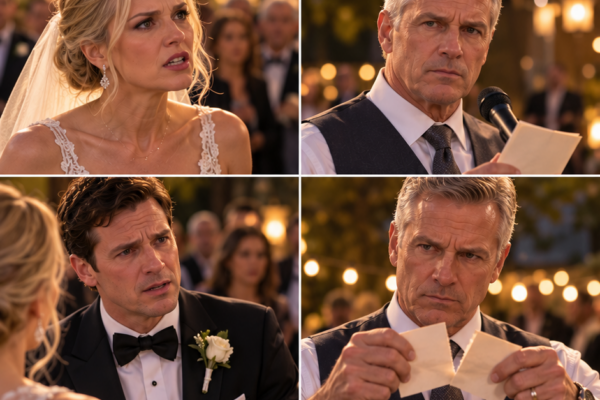
MARGARET BENNETT PAID FOR HER SON’S WEDDING—THEN THE BRIDE TOLD HER TO LEAVE CHAPTER 1 – THE WOMAN WHO PAID FOR EVERYTHING
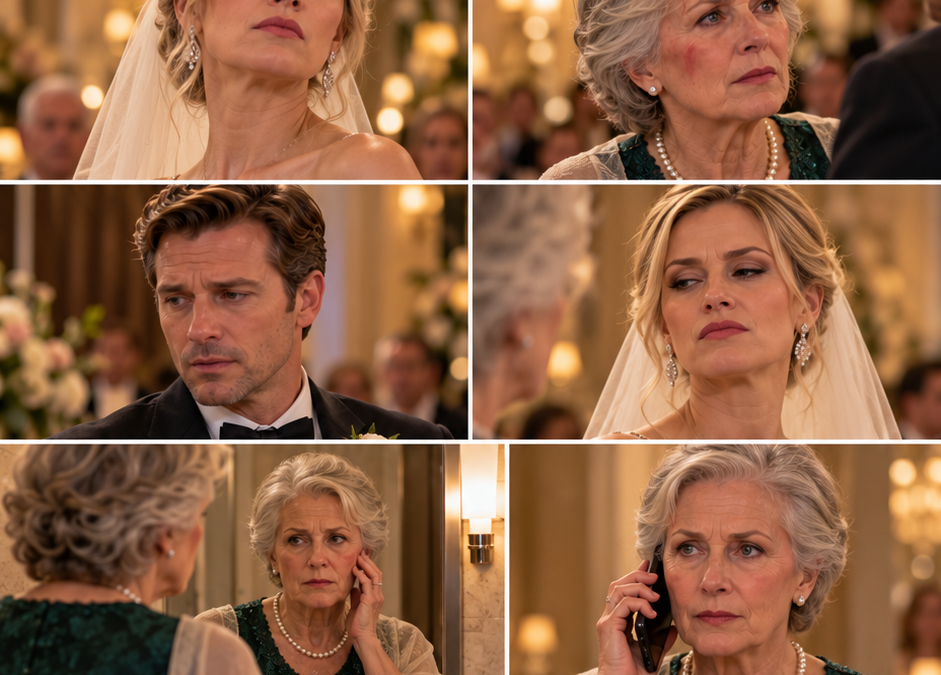
Margaret Bennett heard the champagne glass break before she understood that two hundred and fifty people had just watched her daughter-in-law strike her.
For one strange second, the ballroom seemed to hold its breath.
The live band stopped in the middle of a song.
A violin bow remained suspended above its strings.
One of the bartenders froze with a bottle tilted over an empty glass.
At the nearest table, a woman Margaret had met only once lowered her hand from her mouth without realizing she was doing it.
Crystal chandeliers cast warm gold across the private-estate ballroom. Imported white roses climbed one wall in thick arrangements Margaret had personally approved six weeks earlier. Orchids spilled from silver urns at every table. White linen stretched beneath polished silverware. Candlelight reflected in hundreds of wineglasses.
It had cost more than Margaret wanted to admit.
Not because she was ashamed of the money.
Because she was ashamed of how desperately she had wanted this night to be perfect for her son.
Her cheek burned.
Tiffany’s hand was already lowering.
The bride looked almost unreal beneath the chandeliers.
Her blonde hair had been swept into an elegant updo. Diamonds hung from her ears. Her shimmering white gown had been altered three times because Tiffany said the first seamstress didn’t understand her body, the second didn’t understand luxury, and the third didn’t understand what photographs required.
Margaret had paid all three.
Now Tiffany looked at her as if Margaret were an unpleasant employee who had embarrassed herself in front of important guests.
“You should leave; you’re ruining the atmosphere.”
The sentence was delivered quietly.
That made it worse.
Margaret stared at her.
There had been warning signs.
There were always warning signs when a person finally looked backward.
The first had come eight months earlier when Tiffany rejected the small church where Margaret’s son, Daniel, had once said he wanted to marry.
Too ordinary.
Then the hotel ballroom Margaret had suggested was dismissed because the ceilings were too low.
Then Tiffany discovered the estate.
A sprawling private property forty minutes outside the city, with limestone terraces, manicured gardens, a ballroom built for political fundraisers and charity galas, and a rental price Margaret initially thought had been printed incorrectly.
Daniel had called her three days later.
“Mom, we don’t expect you to cover all of it.”
That was what he had said.
Not all of it.
Margaret smiled sadly now as she remembered the phrase.
Because “not all of it” had gradually become almost everything.
The estate deposit.
The floral designer.
The photographer.
The band.
The catering package.
The additional late-night menu.
The wine upgrade.
The lighting.
The extra transportation.
The custom dance floor Tiffany decided she needed after seeing one online.
Margaret had paid because Daniel was her only child.
And because his father, Robert, had not lived long enough to see him married.
Robert Bennett had died four years earlier after thirty-nine years of marriage.
He had been practical with money, cautious with strangers and almost impossible to impress.
He would have hated the wedding budget.
Margaret knew that.
He probably would have looked at the first estimate, removed his glasses and said, “Does this come with the building?”
She had thought about him several times that week.
She wished she had thought about him harder.
Because Robert had also possessed another quality Margaret had spent four years missing.
He had known when generosity stopped being generosity and became permission.
Margaret slowly turned her face toward her son.
Daniel stood perhaps ten feet away.
Black tuxedo.
White rose boutonniere.
Short brown hair neatly combed.
His skin had gone pale.
He had seen it.
There was no possibility that he hadn’t.
Margaret tightened her fingers around the dark leather purse hanging from her hand.
The sting on her cheek was becoming something deeper now.
Not pain.
Recognition.
“You won’t even ask if I’m hurt?”
Daniel’s lips parted.
For a moment, Margaret thought he might finally say something.
She watched his eyes move toward Tiffany.
Then toward the guests.
Then toward the floor.
He said nothing.
That silence reached somewhere inside Margaret that Tiffany’s hand never could.
She had spent thirty-two years defending that boy.
When Daniel was seven and terrified of swimming, Margaret sat beside the pool every afternoon until he crossed it alone.
When he was sixteen and wrecked Robert’s car, Margaret stood between father and son long enough for both of them to calm down.
When Daniel’s first business failed at twenty-seven, she never told anyone how much money she transferred into his account.
When Robert died, Daniel had cried into Margaret’s shoulder at the funeral and whispered that they were all they had left.
All they had left.
Margaret could still hear him saying it.
Now two hundred and fifty people stood beneath chandeliers she had paid for while her son looked away.
Tiffany gave a small breath through her nose.
Not quite a laugh.
Something closer to contempt.
“You’re just a resentful old woman with money.”
A few feet away, one of the servers looked down.
Margaret noticed it.
She noticed everything suddenly.
The violinist staring at her shoes.
A cousin of Daniel’s shifting uncomfortably near the stage.
Tiffany’s maid of honor pretending to adjust a napkin.
The venue manager standing near the far doors with his hands clasped in front of him.
Most of all, she noticed Daniel.
Still silent.
Margaret felt something inside her settle.
She had expected humiliation to feel hot.
It didn’t.
It felt cold.
Very cold.
She lifted her purse.
Tiffany’s posture changed.
Only slightly.
Perhaps she expected Margaret to leave.
Perhaps that was what all of them expected.
The widowed mother would wipe her face, gather what dignity remained and disappear quietly so the young couple could return to their perfect evening.
Margaret did walk away.
But not toward the exit.
She moved through a narrow corridor beside the ballroom and entered the women’s restroom.
Inside, everything was marble, brass and soft amber light.
She locked the door behind her.
Then she walked to the mirror.
The woman looking back at her seemed older than the one who had left home three hours earlier.
There was a red mark across her cheek.
Her pearl earrings were still straight.
Her silver-gray hair was still perfectly arranged.
Her emerald dress had not changed.
Nothing visible explained why Margaret suddenly felt as though an entire version of her life had just collapsed.
She placed one hand against the marble sink.
For three breaths, she allowed it to tremble.
Only three.
Then she opened her purse.
Her phone lay beneath a folded handkerchief, a lipstick she had never used that evening and the small leather wallet Robert had given her on their thirtieth anniversary.
Margaret picked up the phone.
The venue manager answered on the second ring.
“Mrs. Bennett?”
Margaret looked at herself in the mirror.
“Activate the cancellation clause.”
There was silence on the other end.
Not confusion.
Recognition.
Because the venue manager knew exactly what she meant.
His name was Harold Pierce.
He had managed private events for almost twenty years, and unlike Tiffany, he had read every contract associated with the wedding.
Margaret had too.
That was something almost nobody in the ballroom knew.
Months earlier, when Tiffany began adding increasingly expensive services, Margaret had insisted that any contract funded entirely from her accounts remain under her name.
Daniel had barely noticed.
Tiffany had complained once.
Margaret remembered the conversation.
“Why does your name have to be on everything?”
“Because I’m paying for it.”
Tiffany had rolled her eyes.
At the time, Margaret had interpreted the gesture as youthful impatience.
Robert would not have.
Robert would have remembered it.
And perhaps Margaret finally did.
Harold spoke carefully.
“Are you certain?”
Margaret looked at the mark on her cheek.
Then she remembered Daniel looking away.
“Yes.”
She ended the call.
For several seconds, she remained at the sink.
No triumphant smile appeared.
No satisfaction.
Only grief.
She had imagined this wedding for years.
Not this wedding exactly.
Nothing this extravagant.
But she had imagined standing near Daniel while he danced with the woman he loved.
She had imagined Robert somehow being present through memory.
She had imagined gaining a daughter.
Margaret closed her eyes.
Then someone tried the restroom handle from the other side.
“Occupied,” Margaret said.
Her voice sounded completely normal.
That surprised her.
She waited another moment and returned to the ballroom.
The transformation had already begun.
At first, it was subtle.
One bartender placed a bottle beneath the counter.
Another began covering open wine.
Near the stage, the drummer leaned toward the bandleader.
The bandleader nodded once.
Two musicians began closing instrument cases.
A catering supervisor approached Harold near the main service door.
Harold showed him something on a tablet.
The man looked across the ballroom toward Margaret.
Then nodded.
Guests began noticing.
A murmur moved through the room.
Tiffany had been speaking to two bridesmaids.
She turned as a server removed a silver champagne bucket from the head table.
“What are you doing?”
The server did not answer.
He looked toward his supervisor.
Tiffany followed his gaze.
Harold Pierce was walking toward her.
He carried a thick stack of contracts.
Daniel stepped closer to his wife.
Margaret remained several yards away.
She did not approach them.
She didn’t need to.
Harold reached the head table and placed the contracts on the white linen.
The weight of the stack made several forks jump softly against their plates.
He opened the first page.
Tiffany stared at him.
“What is this?”
Harold didn’t respond to the question.
Instead, he looked directly at her.
His expression remained professional.
“Every contract here carries Mrs. Bennett’s name.”
Something changed in Tiffany’s face.
It was small enough that most guests probably missed it.
Margaret did not.
The anger remained.
But beneath it appeared the first hint of uncertainty.
Tiffany looked down at the page.
Then toward Margaret.
The ballroom had become so quiet that Margaret could hear a chair leg scrape across the polished floor.
Daniel looked at the contracts.
Then at his mother.
“Mom—”
Margaret raised one hand.
Daniel stopped.
It was the first time all evening he had responded immediately to her.
Tiffany’s uncertainty vanished behind irritation.
“This is ridiculous.”
Harold remained still.
Tiffany pointed toward the bar.
“Tell them to keep serving.”
“I’m unable to do that.”
“Why?”
“The individual responsible for those services has withdrawn authorization.”
Tiffany looked at Margaret again.
“You cannot be serious.”
Margaret said nothing.
The mark on her cheek no longer felt hot.
She could see several guests quietly taking their phones from tables.
Not recording.
Calling drivers.
Ordering cars.
Realizing the evening was changing.
The band began carrying instruments toward the side exit.
Tiffany stepped around the table.
“You don’t get to destroy my wedding because you’re embarrassed.”
Margaret’s fingers tightened around the handle of her purse.
Embarrassed.
That word almost made her laugh.
But there was nothing funny left.
“I’m not destroying anything,” Margaret said quietly.
“You stopped the bar.”
“You told me to leave.”
“I told you to stop creating a scene.”
“You struck me.”
Tiffany’s eyes flicked toward the guests.
“Don’t make this dramatic.”
Margaret looked at Daniel.
He had not spoken.
Again.
That silence answered something she had been refusing to ask for months.
Tiffany had become demanding.
Cruel, occasionally.
Dismissive.
But Tiffany was not the person Margaret had raised.
Daniel was.
Margaret had spent months blaming Tiffany for changing him because that explanation hurt less than acknowledging that he had participated willingly.
“Daniel,” Margaret said.
His eyes finally met hers.
“Did you know she planned to ask me to leave tonight?”
His face changed.
It was enough.
Margaret felt the answer before he gave it.
“Mom, I didn’t know she was going to—”
“That wasn’t my question.”
Daniel swallowed.
Behind him, Tiffany’s expression sharpened.
Margaret waited.
Daniel looked around the ballroom.
At the guests.
At Tiffany.
Then back at his mother.
“She said things had been tense.”
Margaret remained still.
“And?”
“She thought maybe after dinner you could go home.”
The words were almost whispered.
Margaret stared at him.
After dinner.
The cake she had paid for.
The band she had paid for.
The room she had paid for.
The flowers she had paid for.
The meal she had paid for.
And somewhere, before Margaret even arrived, her son and his bride had discussed when she should be removed from the wedding she had financed.
Something deep inside Margaret finally broke.
Not loudly.
Cleanly.
Like a thread pulled until it simply ceased to exist.
Tiffany folded her arms.
“See? We were trying to avoid exactly this.”
Margaret looked at her.
Then she looked at Daniel.
“No,” Margaret said. “You were trying to avoid me discovering exactly this.”
Daniel’s face went white.
Harold quietly closed the contract folder.
The guests nearest them stopped pretending not to listen.
Margaret reached inside her purse.
Daniel stiffened as if expecting another document.
Instead, she removed the old leather wallet Robert had given her.
She ran her thumb once across its worn edge.
And suddenly she remembered something her husband had told her during the final year of his life.
They had been sitting on the back porch after Daniel left following an argument about money.
Robert had watched their son’s car disappear down the driveway.
Then he had said, “Margaret, helping someone stand is love.”
She had looked at him.
Robert’s voice had grown quieter.
“Carrying them after they’ve learned to walk is fear.”
At the time, she had been angry with him.
Now, four years later, standing beneath chandeliers she had purchased for a son who could not ask whether she was hurt, Margaret finally understood.
She put the wallet back inside her purse.
Then she looked at Harold.
“Please proceed.”
Harold nodded.
Tiffany stared between them.
“Proceed with what?”
Margaret did not answer.
For the first time that night, Tiffany looked genuinely afraid.
And Daniel finally stepped toward his mother.
But Margaret had already turned away.
You Might Also Enjoy
SHE TOLD HIS MOTHER THE MANSION WASN’T HERS—THEN SECURITY BROUGHT OUT THE TABLET CHAPTER 2 — THE $1.85 MILLION TRANSFER