ELEANOR CARTER OPENED HER LATE HUSBAND’S LOCKED CHEST—THEN HER SON BEGGED HER NOT TO READ THE PAPERS CHAPTER 1 – THE SCRATCHES ON HENRY’S LOCK
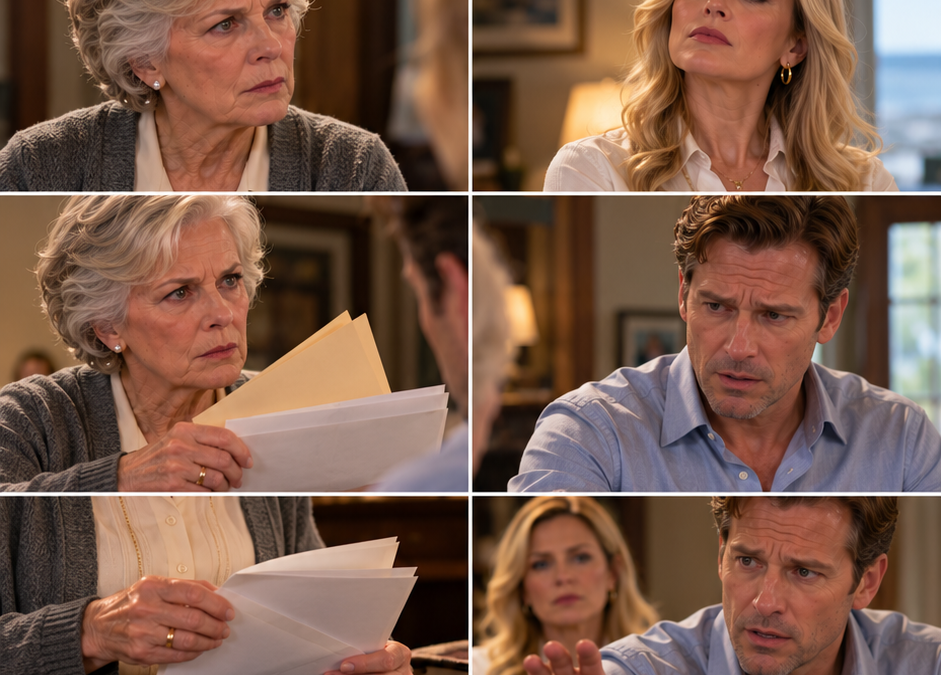
The first thing Eleanor Carter noticed was not the blanket.
It was the scratches.
Three fresh silver marks cut across the old brass lock on Henry’s cedar chest, bright against metal that had darkened with age.
Eleanor stood in the doorway of her late husband’s upstairs office and felt the handle of her handbag slide slowly down her wrist.
Nothing else in the room looked quite right either.
The heavy cedar chest had been dragged nearly two feet away from the wall.
A folded blanket lay crumpled beside it, as though someone had thrown it there in a hurry.
The desk chair had been moved.
One drawer stood open by half an inch.
And Daniel, her only son, was standing near the window with his eyes closed.
Claire stood behind the chest.
Arms crossed.
White linen shirt without a wrinkle.
Gold necklace catching the late-afternoon light.
Her expression wore the polished calm Eleanor had learned to distrust.
For almost five seconds, nobody spoke.
Outside, gulls cried somewhere beyond the line of houses.
The sea was too far away to see from the office window, but the air still carried salt through the cracked sash.
Eleanor stepped closer to the chest.
“Mom.”
Daniel’s voice came out thin.
She ignored him.
Henry had bought the chest before Daniel was born.
It had belonged to his grandfather first, then his father, then him.
Not valuable in the way Claire measured value.
No appraisal.
No auction-house history.
No story that impressed dinner guests.
But Henry had kept certain things inside it that mattered only because he had decided they mattered.
Old letters.
Military photographs from his father.
Property records.
Insurance papers.
A faded map of the coastline marked with places he and Eleanor once planned to visit.
For thirty-eight years of marriage, Henry had kept the little brass key in the back of his desk drawer.
After he died, Eleanor moved it into her jewelry box.
She had not opened the chest in almost three years.
Now the key was already in the lock.
Eleanor looked at Daniel.
His eyes finally opened.
“Where did you get that?”
He rubbed the back of his neck.
A habit inherited from Henry.
Same crease between the eyebrows.
Same pause before a difficult answer.
“I found it.”
“Where?”
Daniel glanced toward Claire.
That was answer enough.
Eleanor turned back to the chest.
She lifted the heavy lid.
The hinges gave a low wooden groan.
Cedar scent rose immediately.
So did something else.
Memory.
Henry kneeling here in his shirtsleeves, looking for a deed.
Henry laughing because Daniel had hidden a toy car inside when he was six.
Henry closing the lid with both hands and telling Eleanor not everything needed to live in a filing cabinet.
Her throat tightened.
She pushed the feeling down.
The top layer inside the chest was disturbed.
A cream-colored folder sat crooked against the side.
Two envelopes had been moved.
A stack of old photographs had shifted from beneath a leather portfolio.
Eleanor looked at Claire.
Claire’s smile tightened.
Eleanor rested one hand against the open lid.
“Looking for extra sheets in a locked chest?”
Claire tilted her head.
“Eleanor, this house is simply too much for you.”
There it was.
Not denial.
Not apology.
A conclusion.
Eleanor felt something in her grow still.
This house is too much for you.
Claire had been saying versions of that sentence for almost a year.
Never directly at first.
The stairs must be exhausting.
The garden is becoming impossible.
The roof will need work soon.
Wouldn’t something smaller be easier?
Then came listings.
Brochures.
Phone numbers for real estate agents.
Conversations that began after dinner when Eleanor was tired and less willing to argue.
Once, Claire had left a retirement-community brochure on the kitchen counter as if it had wandered in by itself.
Daniel had laughed awkwardly when Eleanor asked about it.
“Claire’s just trying to help.”
Help.
That word had become remarkably flexible.
Eleanor reached into the chest.
Her fingers closed around the cream folder.
Daniel stiffened.
She lifted it.
Beneath it lay a plain white envelope.
Her name had been written across the front.
ELEANOR.
Not Henry’s handwriting.
Not Claire’s either.
Daniel’s.
Eleanor stared at it.
Then at her son.
“You hid this in your father’s chest.”
Daniel raised one trembling hand.
“Mom.”
Eleanor did not move.
“Why?”
Claire answered before he could.
“You’re making this more dramatic than it is.”
Eleanor looked at her.
“Am I?”
Claire uncrossed her arms.
“Eleanor, no one is trying to hurt you.”
The sentence was so carefully delivered that Eleanor almost admired it.
People often said that when they had already decided harm was justified.
Daniel stepped forward.
“Mom, please give me that.”
Eleanor looked at him.
There was panic in his face now.
Not irritation.
Not guilt alone.
Panic.
She broke the flap.
The envelope had never been sealed.
Three sheets of paper rested inside.
No letter.
No personal note.
Formal pages.
Her eyes moved over the first few lines.
She saw her name.
Daniel’s.
A law firm’s header.
Several references she did not fully understand.
And one word appearing more than once.
Petition.
Eleanor lifted her eyes.
“Daniel, what exactly were you planning to petition?”
Daniel went gray.
Claire’s face changed.
Only slightly.
But Eleanor saw it.
For the first time since she arrived home two hours earlier, Claire was afraid.
Daniel looked at the floor.
“Nothing happened.”
“That wasn’t my question.”
“Mom, please.”
Eleanor kept reading.
The wording was dense.
Formal.
It referred to capacity.
Financial management.
Temporary authority.
Her pulse slowed instead of quickening.
That frightened her.
She turned the page.
Another reference to medical evaluation.
Another to decision-making.
Another to property.
Eleanor looked up.
“Was this about me?”
Daniel dragged both hands over his face.
Claire stepped in.
“It was about protecting you.”
Eleanor turned toward her.
“From what?”
Claire hesitated.
“From making impulsive decisions.”
Eleanor looked at the chest.
Then at the room.
Then back at Claire.
“What impulsive decision?”
Claire’s eyes flicked toward Daniel.
Eleanor saw it.
A conversation had already happened.
Many conversations, probably.
Daniel sank into Henry’s desk chair.
“Mom, it never went anywhere.”
“Why was it written?”
Silence.
“Daniel.”
He stared at his hands.
“We talked to someone.”
“Who?”
“A lawyer.”
Eleanor waited.
Daniel swallowed.
“Just for advice.”
“Advice about having me declared incapable of managing my own affairs?”
“No.”
Claire answered too quickly.
“Not declared incapable.”
Eleanor looked at her.
“What phrase did you prefer?”
Claire’s mouth tightened.
Daniel whispered, “Temporary guardianship.”
The room seemed to change temperature.
Eleanor held the papers in both hands.
The phrase felt impossible.
Not because she did not understand it.
Because she did.
Her sister had once gone through something similar with an elderly uncle after a stroke.
There had been court hearings.
Doctors.
Arguments about accounts and property.
Years of resentment.
Eleanor had sat beside Henry afterward and said she hoped nobody ever mistook age for incompetence.
Henry had taken her hand.
“Then don’t let them.”
She remembered his exact words.
Daniel finally looked up.
“It wasn’t supposed to be like that.”
Eleanor’s voice stayed level.
“What was it supposed to be like?”
He opened his mouth.
Claire stepped closer.
“You’ve been making decisions without thinking them through.”
Eleanor almost laughed.
“What decisions?”
“The house.”
There it was.
Eleanor went completely still.
“What about my house?”
Claire exhaled through her nose.
“You told us last month you were thinking of selling.”
“I am.”
Daniel looked up sharply.
“You are?”
Eleanor turned to him.
“Yes.”
Claire’s face changed again.
Alarm.
“To who?”
“I haven’t decided.”
Claire looked at Daniel.
That glance told Eleanor everything.
The papers were not about concern.
Not primarily.
They were about timing.
Eleanor folded the documents once.
“How long have you known I might sell?”
Daniel rubbed his neck again.
“Since you mentioned it.”
“And when did you contact the lawyer?”
He said nothing.
“Daniel.”
“Three weeks ago.”
Eleanor stared at him.
She had mentioned selling the house twenty-six days earlier.
The call had come almost immediately.
“What exactly did you tell this lawyer?”
Claire stepped forward.
“We told her you were grieving.”
Eleanor looked at her.
“I’ve been widowed for three years.”
“Grief doesn’t have a schedule.”
“No, Claire. But apparently your paperwork does.”
Claire’s polished expression cracked for a second.
Daniel stood.
“Mom, stop.”
Eleanor turned.
“Stop what?”
“Making Claire the villain.”
Eleanor stared at him.
Then she laughed.
A small sound.
Not amused.
“Daniel, your name is on these pages too.”
His face collapsed.
That hurt him.
Good, Eleanor thought.
Then immediately disliked herself for thinking it.
She did not want punishment.
She wanted truth.
The office door was open.
Beyond it, the hallway led toward the stairs.
Downstairs, she could hear faint movement.
Boxes being shifted.
Furniture scraped earlier that day.
Claire and Daniel had arrived the previous week to “help Eleanor get organized.”
That was the phrase.
They had brought storage boxes.
They had started sorting closets.
They had moved Henry’s winter coats without asking.
They had emptied half the guest room.
Claire had placed sticky notes on furniture.
KEEP.
DONATE.
SELL.
Eleanor had removed every one.
This morning, she returned from a two-night trip to visit an old friend and found three unfamiliar cars outside.
Daniel had claimed they belonged to people helping with “a few things downstairs.”
Eleanor had demanded they leave.
Then she came upstairs.
Now the meaning of everything shifted.
She looked at Daniel.
“Who were those people?”
He frowned.
“What?”
“The strangers downstairs when I arrived.”
Claire crossed her arms again.
“That has nothing to do with this.”
Eleanor turned.
“Then you’ll have no difficulty answering.”
Claire said nothing.
Daniel whispered, “Estate people.”
Eleanor’s stomach tightened.
“What kind of estate people?”
“Appraisers.”
Eleanor stared at him.
“You had appraisers in my house.”
“Just informal.”
“Without permission.”
“Mom—”
“In my house.”
Daniel looked away.
Eleanor looked at the papers again.
A petition.
Appraisers.
Discussions about selling.
A locked chest opened.
Her belongings being sorted.
The pattern became visible all at once.
She sat slowly in Henry’s chair.
Claire watched her closely.
For a moment, concern crossed her face.
Maybe real.
Maybe calculation.
“Eleanor.”
Eleanor lifted one hand.
Claire stopped.
The chair creaked beneath her.
Henry had used this chair every morning after retirement.
He read bills here.
Wrote letters.
Argued with insurance companies.
Planned vacations they never took.
Eleanor ran her fingertips across the wooden arm.
Then she looked at Daniel.
“If I had not come home early today, what would have happened?”
Daniel’s face went blank.
“What do you mean?”
“You thought I was returning tomorrow.”
Silence.
“Why were the appraisers here today?”
Daniel looked at Claire.
Eleanor followed his eyes.
Claire’s jaw tightened.
Then she said, “We needed a realistic value.”
“For what?”
“Planning.”
“Whose planning?”
Claire exhaled.
“Everyone’s.”
Eleanor leaned back.
“No. Try again.”
Claire looked irritated now.
“Daniel has spent years worrying about you.”
Eleanor looked at her son.
Daniel did not meet her eyes.
“You live alone in a large house.”
“So?”
“You barely use the upstairs.”
“I am sitting upstairs right now.”
Claire ignored that.
“The stairs are steep.”
“I climb them.”
“The property taxes are high.”
“I pay them.”
“The maintenance is excessive.”
“I maintain it.”
“Until you can’t.”
Eleanor went silent.
There it was.
Not what is.
What might be.
A future weakness turned into present permission.
Eleanor folded the papers and placed them back inside the envelope.
Daniel stepped closer.
“What are you doing?”
“Thinking.”
“About what?”
Eleanor looked at him.
“How long I have been mistaking your worry for love.”
Daniel flinched.
“That’s not fair.”
“No.”
Eleanor nodded slowly.
“What’s unfair is opening your dead father’s chest to hide papers designed to take decisions away from your mother.”
Daniel’s eyes filled.
Claire’s expression hardened.
“We were trying to prevent you from making a mistake.”
Eleanor stood.
“And what mistake frightened you this much?”
Claire said nothing.
Eleanor looked at Daniel.
He stared toward the window.
Finally, he said it.
“If you sell the house, everything changes.”
Eleanor’s voice softened.
“For whom?”
Daniel closed his eyes.
And in that second, Eleanor understood the question was much larger than a house.
You Might Also Enjoy
THEY TOLD HER DINNER WAS AT 8:30—THEN THE MANAGER REVEALED THE TRUTH CHAPTER 3 — THE BILL THEY COULD NOT LEAVE WITH HER

SHE TOLD HIS MOTHER THE MANSION WASN’T HERS—THEN SECURITY BROUGHT OUT THE TABLET CHAPTER 2 — THE $1.85 MILLION TRANSFER