HER SON GAVE HER A FOLDING CHAIR—THEN SHE ASKED WHAT SHE PAID EVERY MONTH CHAPTER 3 — WHAT SHE STOPPED PAYING FOR
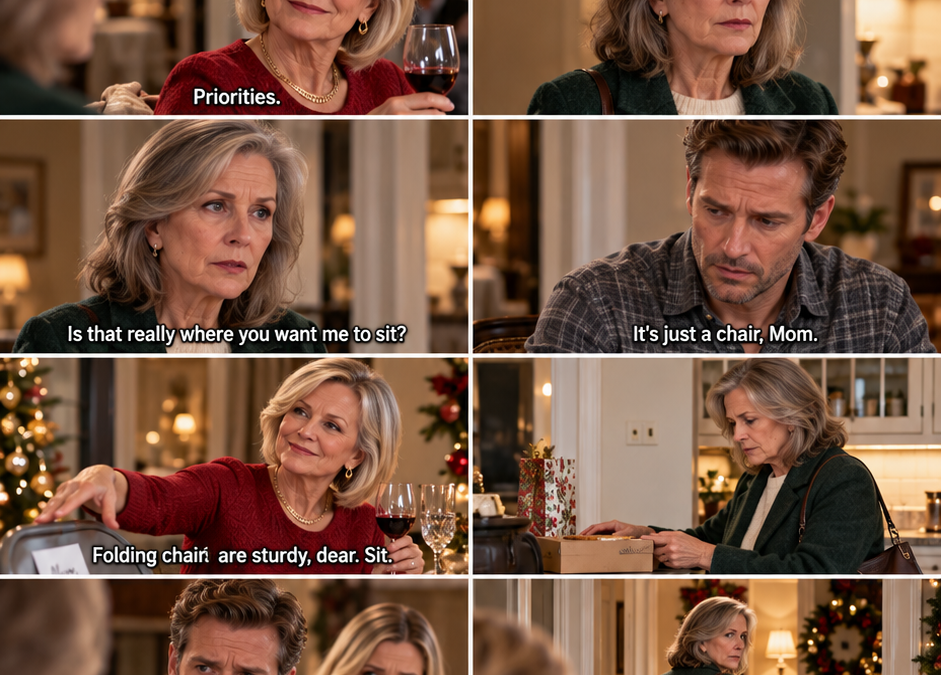
Mother did not stay for Christmas dinner.
That mattered to Michael more than he admitted.
He followed her into the front hall.
“Mom.”
She put on her gloves.
Behind him, the dining room remained silent.
Denise was no longer drinking wine.
Ashley sat in front of the laptop.
The children were upstairs with new toys, unaware that the adults had just discovered their household was balancing on debt and concealment.
Michael stood between his mother and the door.
Not blocking it.
Almost asking permission to speak.
“What?”
Mother said.
His eyes filled.
“I am sorry about the chair.”
She studied him.
“Are you?”
“Yes.”
“Why?”
Michael frowned.
“What do you mean?”
“Why are you sorry?”
He looked toward the dining room.
“Because it was disrespectful.”
Mother waited.
“And?”
He swallowed.
“Because I knew you would let it go.”
There.
The important part.
His voice broke slightly.
“I knew Denise wanted the seat.”
“I knew Ashley didn’t want an argument.”
“And I knew you would probably say it didn’t matter.”
Mother looked at him.
“So I used your kindness to make my day easier.”
Her throat tightened.
“Yes.”
Michael nodded.
“I’m sorry.”
That apology she could believe.
Not forgive instantly.
Believe.
She opened the door.
Cold Boston air entered.
Michael rubbed his arms.
“Where are you going?”
“Home.”
“Can we talk tomorrow?”
Mother considered.
“Yes.”
Relief appeared.
“But I am still calling my attorney.”
It disappeared.
“Mom.”
She looked at him.
“I am not punishing you.”
“That feels like punishment.”
“No.”
She adjusted her purse.
“You built financial expectations around things that do not belong to you yet.”
His eyes lowered.
“My attorney is going to correct that.”
She stepped outside.
Michael called after her.
“What happens to the house?”
Mother turned.
The question hurt.
Not because he asked.
Because it came so quickly.
She saw him realize it too.
He covered his face briefly.
“God.”
Mother waited.
“I did it again.”
“Yes.”
He lowered his hands.
“I’m sorry.”
She looked at him for a long moment.
“Tomorrow, Michael.”
Then she left.
The pie stayed on the kitchen counter.
The gift bag stayed for the children.
The folding chair remained untouched.
Mother drove home through streets dusted with old snow.
Christmas lights blurred behind her windshield.
For years she had thought loneliness would be the great danger of widowhood.
It wasn’t.
The greater danger had been believing that being needed was the same as being loved.
Michael needed her constantly.
Money.
Childcare.
Insurance.
Emergencies.
Advice.
Contacts.
She had allowed that dependence to reassure her after her husband died.
If Michael still needed her, then she still had a role.
That thought was difficult to admit.
By the time she reached home, it was also freeing.
The next morning, she called her attorney.
She did not tell him a dramatic story.
She told him facts.
Her son had listed an expected inheritance on a loan application.
She wanted to know how to prevent her estate from being treated as a present-day asset.
Her attorney asked questions.
Then explained options.
By New Year’s Eve, Mother had signed a revised estate plan.
Her home remained entirely hers during her lifetime.
Her investments remained available for her retirement, healthcare and anything else she chose.
Upon her death, the remaining estate would no longer pass directly to Michael.
A trust would receive it.
An independent trustee would control distributions.
Michael could not pledge future inheritance.
Could not assign it to lenders.
Could not borrow against it.
Could not access his children’s share.
A substantial portion would be reserved for Lily and her brother’s education and early adulthood.
Michael remained a beneficiary.
Mother did not erase him.
That distinction mattered to her.
She was establishing boundaries.
Not revenge.
When Michael came to her house on January second, he brought a folder.
Mother noticed immediately.
“No food?”
He almost smiled.
“No.”
“No laundry?”
“No.”
“No broken appliance?”
“Not today.”
Mother opened the door.
“Come in.”
He sat at her dining table.
Not her husband’s old chair in the study.
He seemed to notice where he placed himself now.
Mother made tea.
When she returned, Michael pushed the folder toward her.
“What is this?”
“Everything.”
She opened it.
Debt statements.
The home-equity line.
Credit cards.
Business litigation.
Tax liabilities.
Mortgage statements.
Business accounts.
A repayment schedule.
Mother looked at him.
“Ashley helped?”
“Yes.”
“Did she know you were coming?”
“Yes.”
Mother nodded.
Good.
Michael continued.
“We are selling the truck.”
She raised an eyebrow.
“My work truck?”
“Not that one.”
He gave a tired smile.
“The new SUV.”
“Good.”
“We canceled the renovation we were planning upstairs.”
Mother said nothing.
“We are selling some equipment I don’t need.”
He looked embarrassed.
“And I took a job with another contractor three days a week.”
That surprised her.
“You’re closing the business?”
“No.”
He shook his head.
“Reducing it.”
“The business can handle smaller jobs.”
“I need stable income until the lawsuit is resolved.”
Mother nodded.
“That sounds sensible.”
Michael almost laughed.
“I wish you had said it was brilliant.”
“No.”
He smiled faintly.
“Right.”
Mother looked through the folder.
“How much total debt now that everything is counted?”
Michael answered without hesitation.
“One hundred seventeen thousand eight hundred forty.”
Exact.
No “about.”
No “roughly.”
Mother appreciated that.
“And available cash?”
“Fifteen thousand three hundred.”
“Mortgage current?”
“Yes.”
“Home-equity line?”
“I paid the overdue installment.”
“With what?”
“Sold some equipment.”
Mother looked at him.
“Good.”
Again no offer.
She could feel him waiting for one.
Then not waiting.
That was new.
He looked toward her.
“I also moved the phone plan.”
Mother nodded.
“Insurance starts under my name February first.”
Another nod.
“The streaming accounts are canceled except one.”
“Which one?”
He smiled.
“The kids voted.”
Mother almost smiled back.
“Reasonable democracy.”
Then Michael’s expression became serious.
“I need to tell you something.”
Mother waited.
“I called the lender.”
Her face hardened slightly.
“I corrected the inheritance disclosure.”
“What did you tell them?”
“That I had no legal right to treat your estate as an asset.”
Mother watched him carefully.
“And?”
“They removed it from the file.”
“Did it affect anything?”
“Yes.”
His jaw tightened.
“The home-equity line renewal terms are worse.”
Mother nodded.
He waited.
She said nothing else.
Finally Michael smiled weakly.
“You’re not offering to compensate for that.”
“No.”
“I know.”
He looked down.
“I think that is good.”
Mother felt something soften.
Then she reached for her own folder.
Michael saw it.
His face changed.
“The will.”
“Trust.”
He swallowed.
“Okay.”
Mother placed it between them.
“I am not showing you numbers.”
He nodded.
“You do not need them.”
Another nod.
“The house no longer passes directly to you.”
His face tightened despite himself.
Mother noticed.
Michael noticed her noticing.
He exhaled.
“I’m trying.”
“I know.”
She continued.
“A trust receives the estate.”
“An independent trustee controls distributions.”
“The grandchildren have protected shares.”
Michael listened.
“You remain included.”
His eyes lifted.
“Why?”
Mother smiled sadly.
“Why does everyone keep asking me that?”
He looked embarrassed.
“Because after what I did…”
“You are still my son.”
His eyes filled.
Mother continued.
“But being my son no longer means having financial access to the future version of me who is dead.”
Michael looked down.
The sentence sounded harsh.
Mother let it.
Some truths should not be softened into uselessness.
“The estate exists first for my life.”
“My healthcare.”
“My home.”
“My travel.”
“My comfort.”
“My choices.”
“Whatever remains afterward is whatever remains.”
Michael nodded.
“That makes sense.”
Mother watched him.
“Does it?”
“Yes.”
He looked toward the windows.
Then back.
“I think I treated your money like something frozen.”
She frowned.
“What do you mean?”
“Like you had already finished needing it.”
Mother went still.
Michael continued.
“You had the house.”
“Retirement.”
“Dad’s investments.”
“And I think somewhere in my head, I decided your financial story was complete.”
His voice cracked.
“So anything extra felt available.”
Mother stared.
That hurt because it was honest.
“And yours wasn’t.”
“No.”
“So my stability became the thing you could borrow from.”
“Yes.”
He lowered his head.
“I’m ashamed of that.”
Mother looked at her son.
She remembered him at eight.
At seventeen.
At thirty.
Always running toward whatever came next.
Always certain the next success would repair the last mistake.
She had spent years protecting his momentum.
Now perhaps what he needed was friction.
“You can be ashamed.”
Michael looked up.
“Just don’t use shame as another reason to hide.”
His eyes filled.
“I won’t.”
She nodded.
“We’ll see.”
That was not cruel.
It was accurate.
Trust did not regrow because someone promised it would.
Over the next six months, Michael changed in small, boring ways.
That was how Mother knew the changes might last.
There was no dramatic new business.
No miracle contract.
No sudden windfall.
He simply paid things.
Month after month.
He took the additional contractor work.
He sold the SUV and drove an older pickup.
Ashley returned several expensive household purchases they had made on credit.
They met with a financial planner.
Then a marriage counselor.
Michael disclosed the business problem completely.
Ashley was furious.
She stayed.
But she separated the household budget from Michael’s business accounts and required monthly statements.
Michael resisted at first.
Then stopped resisting.
Denise changed too.
That surprised Mother more.
Three weeks after Christmas, Denise called.
Mother almost did not answer.
Then did.
“I owe you an apology.”
Mother waited.
Denise continued.
“The chair.”
“Yes.”
“I knew what I was doing.”
That surprised her.
Denise’s voice became quieter.
“I have always thought Michael depended on you too much.”
Mother frowned.
“Then why humiliate me?”
“Because I resented it.”
Silence.
Denise continued.
“My daughter married a man who seemed unable to make one financial decision without his mother somewhere behind it.”
Mother listened.
“And instead of blaming Michael, I blamed you.”
That was painfully familiar.
Denise continued.
“I thought if everyone stopped treating you like the center of the family, maybe he would finally grow up.”
Mother almost laughed.
“So you removed my chair.”
“Yes.”
Denise sounded ashamed.
“It was petty.”
“It was cruel.”
“Yes.”
Mother appreciated the lack of defense.
Then Denise added:
“And after learning how much you actually paid, I realized something worse.”
“What?”
“I was criticizing you for enabling him while benefiting from it.”
Mother looked toward the window.
Christmas dinner.
The expensive wine.
The renovated house.
Everyone had been enjoying a life partly subsidized by the woman they moved beside the kitchen.
“I accept the apology.”
Denise went quiet.
“You forgive me?”
Mother considered.
“I said I accept the apology.”
A pause.
“Forgiveness can take its own time.”
Denise gave a small laugh.
“Fair.”
The following Christmas looked different.
Not poorer.
Simpler.
Michael and Ashley still hosted.
Mother almost declined.
Then Ashley called personally.
“We would really like you here.”
Mother asked:
“Where am I sitting?”
Ashley laughed nervously.
“Wherever you want.”
Mother smiled.
“I’m serious.”
“So am I.”
Mother arrived at noon.
Same green coat.
A new pie.
No gift bag because the grandchildren had already received their presents earlier that morning.
Michael opened the door.
“Merry Christmas, Mom.”
“Merry Christmas.”
He took the pie.
Not her purse.
He knew better now.
When she entered the dining room, she stopped.
The folding chair was gone.
At the table, the chair beside Michael sat empty.
A place card rested there.
MOM.
Denise sat across from him.
She saw Mother notice.
For one second, embarrassment crossed her face.
Then she smiled.
Not smug.
Genuine.
“Apparently priorities changed.”
Mother looked at her.
Denise’s face immediately tightened.
“Too soon?”
Mother laughed.
“Much.”
Everyone laughed.
Even Michael.
Mother sat beside her son.
No one served Denise first.
No one served Mother first either.
The food went around the table normally.
That pleased her more.
She did not want ceremony.
She wanted belonging without debt attached to it.
Halfway through dinner, Michael’s daughter asked:
“Grandma, are you still paying Dad’s phone bill?”
Silence.
Michael nearly choked.
Ashley covered her mouth.
Mother looked at him.
He raised both hands.
“I did not tell her to ask that.”
The girl frowned.
“I heard Mom joking.”
Everyone laughed.
Mother answered:
“No.”
Her granddaughter looked toward Michael.
“So Dad pays for himself now?”
Mother smiled.
“Yes.”
The child nodded solemnly.
“Good job, Dad.”
The room erupted.
Michael laughed hardest.
Then he looked toward Mother.
For a brief second, their eyes met.
No shame.
No rescue.
Something gentler.
Mutual recognition.
After dinner, Michael found Mother alone near the tree.
He handed her an envelope.
She stared suspiciously.
“If this is a bill—”
He laughed.
“It isn’t.”
She opened it.
Inside was a check.
Five thousand dollars.
Mother looked up.
“No.”
Michael raised a hand.
“Before you say anything, this is repayment.”
“I didn’t ask you to repay gifts.”
“Neither did I.”
He looked at the check.
“This is part of the roof money.”
Mother stared.
Michael continued.
“I went through our old texts.”
“You called it a loan.”
Mother remembered.
Barely.
She had long ago stopped expecting repayment.
Michael smiled sadly.
“I think that was part of the problem.”
“You forgot what was gift and what was debt?”
“No.”
His eyes met hers.
“I stopped caring because I assumed you did too.”
Mother felt that.
He continued.
“So take it.”
She looked at the check.
Then at him.
“You have children.”
“I have a budget.”
“You have debt.”
“It includes repayment to you.”
Mother almost smiled.
“You are stubborn.”
“Genetic.”
She slipped the check into her purse.
“Thank you.”
Michael shook his head.
“No.”
He smiled.
“Don’t thank me for paying what I owe.”
Mother’s eyes filled.
That sentence meant more than five thousand dollars.
Two years later, Michael’s business was smaller but profitable.
The lawsuit settled for less than he hoped and more than he feared.
He used the money to pay debt.
Not remodel the kitchen.
Not buy another truck.
Debt.
Ashley told Mother that detail with almost ridiculous pride.
The grandchildren’s future funds remained protected.
Mother traveled.
She took a river cruise with friends.
Replaced her aging car.
Redid her own bathroom.
When Michael heard the price, he laughed.
“Spending my inheritance?”
Mother smiled.
“Aggressively.”
For half a second she watched his reaction.
Then Michael grinned.
“Good.”
And he meant it.
That was when she knew something fundamental had changed.
Years earlier, he might have calculated.
Now he asked whether she liked the tile.
She did.
One quiet Sunday, Michael visited alone.
They drank coffee at Mother’s kitchen table.
He looked around.
“Do you remember that folding chair?”
Mother raised an eyebrow.
“I am not likely to forget it.”
He laughed.
“I still think about it.”
“So do I.”
“I used to think you got angry because of where you sat.”
Mother looked at him.
“And now?”
He thought.
“You got angry because I had turned your generosity into background noise.”
Her throat tightened.
“Yes.”
Michael nodded.
“I didn’t see what you were doing for us because I expected it to continue.”
Mother looked toward her wedding band.
Her husband would have understood the sentence.
Michael continued.
“I thought Mom was just… Mom.”
“Always there.”
“Always helping.”
“Always okay.”
His eyes filled.
“I forgot you were a person making choices every time.”
Mother reached across the table.
She covered his hand.
That gesture was not financial.
Not strategic.
Not a rescue.
Just affection.
“You remember now.”
Michael nodded.
“Yes.”
Outside, winter light lay across the yard.
Inside, there were no invoices.
No banking apps.
No emergency transfers.
No discussions about inheritance.
Just coffee cooling between them.
Mother had spent years believing love meant ensuring Michael never fell too far.
What she finally learned was harder and kinder.
Sometimes love meant allowing the bill to arrive in the correct person’s name.
Sometimes love meant keeping your own chair.
And sometimes the most important thing a mother could stop paying for was not a phone plan, an insurance premium, or a mortgage.
It was the illusion that her grown son could build a stable life while someone else quietly absorbed every consequence.
You Might Also Enjoy

THEY TOLD HER DINNER WAS AT 8:30—THEN THE MANAGER REVEALED THE TRUTH CHAPTER 3 — THE BILL THEY COULD NOT LEAVE WITH HER

SHE TOLD HIS MOTHER THE MANSION WASN’T HERS—THEN SECURITY BROUGHT OUT THE TABLET CHAPTER 2 — THE $1.85 MILLION TRANSFER