THE BRIDE TOLD HER TO LEAVE—THEN JUDITH SAID THE VENUE MANAGER NEEDED TO KNOW CHAPTER 3 — WHAT SHE REFUSED TO FINANCE
Jacob arrived at Judith’s house at nine the next morning.
Alone.
Exactly as she asked.
Judith saw his car through the front window.
For several seconds, he remained inside it.
Then he opened the door.
Black trousers.
White shirt.
No tuxedo jacket.
No boutonniere.
No wedding photographs.
He looked like a man returning from something rather than beginning something.
Judith opened the front door before he knocked.
“Come in.”
Jacob entered.
The house smelled faintly of coffee.
He looked toward the dining table.
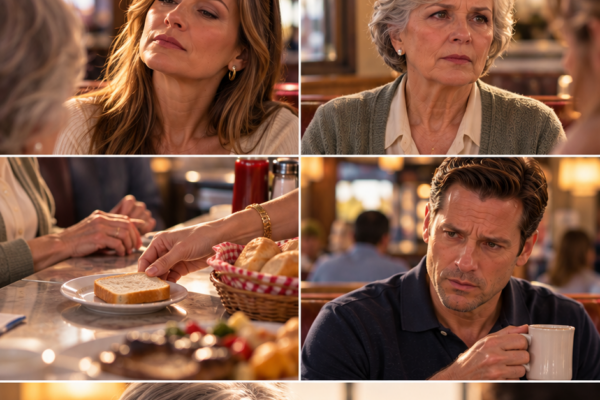
Two cups waited.
No breakfast.
Judith had decided coffee was enough.
Jacob sat.
Judith took the opposite chair.
For a moment neither spoke.
Then Jacob looked at her lavender dress.
“You’re still wearing it.”
Judith glanced down.
She had slept only a few hours and changed back into it that morning because it felt easier than opening her closet.
“I suppose Amanda chose well.”
Jacob closed his eyes.
“Mom.”
Judith’s mouth almost softened.
“Too soon?”
“Yes.”
“Fair.”
A tiny laugh escaped him.
Then disappeared.
He looked at his hands.
“Amanda didn’t sleep.”
Judith waited.
“She took the ring off.”
Her expression changed slightly.
“Not because she is ending the marriage.”
Judith nodded.
“She said she doesn’t want to wear something she now knows was partly debt until we decide what we’re doing.”
Judith looked toward his bare left hand.
His wedding band remained there.
“What are you doing?”
Jacob swallowed.
“Trying not to lie today.”
It was a good answer.
Judith folded her hands.
“Start.”
He breathed in.
“The forty-seven thousand is real.”
“Yes.”
“I have another eight on a card you don’t know about.”
Judith’s jaw tightened.
“So fifty-five.”
“Yes.”
“I have enough income to make the payments.”
“But?”
“I have been moving balances around.”
Judith nodded.
“Using new debt to hide old debt.”
“Yes.”
“And I kept thinking if the wedding was paid off, everything would stabilize.”
Judith waited.
Jacob laughed bitterly.
“I said that about the car.”
“And the business.”
“And the taxes.”
He looked at her.
“I know.”
Silence.
Judith took a sip of coffee.
“What did Amanda know?”
“Less than she should have.”
“That wasn’t my question.”
Jacob looked away.
“She knew I had debt.”
“How much?”
“I told her around fifteen.”
Judith’s eyes hardened.
“So she married you believing fifteen.”
“Yes.”
“When it was fifty-five.”
“Yes.”
Judith looked down.
“That is not wedding stress.”
“No.”
“That is deception.”
“Yes.”
He did not soften it.
Good.
Judith continued.
“And my signature?”
His face crumpled.
“I copied it.”
She knew.
Hearing it plainly still hurt.
“I kept the original PDF from the venue deposit.”
Judith’s fingers tightened around her mug.
“I changed the form.”
He swallowed.
“I told myself you had already agreed to help.”
Judith looked at him.
“You told yourself consent carried forward.”
“Yes.”
“Because I am your mother.”
His eyes filled.
“Yes.”
Judith nodded slowly.
“That ends.”
“I know.”
“No.”
Her voice sharpened.
“You need to hear the full sentence.”
Jacob looked up.
“That ends whether our relationship survives this or not.”
His face changed.
Judith continued.
“You never use my signature.”
“You never offer my money.”
“You never include my assets in your plans.”
“You never tell Amanda I agreed to something until I have said it myself.”
Jacob nodded after each sentence.
Judith watched him closely.
Then she opened a drawer beside the table.
She removed a blue folder.
Jacob saw it.
Something changed in his face.
“What is that?”
“My estate documents.”
His eyes closed.
“Mom.”
“I changed them before the wedding.”
He stared.
“Before?”
“Yes.”
“Why?”
Judith considered him.
“Because yesterday was not the first time I realized something was wrong.”
Jacob lowered his head.
Three months earlier, he had asked casually about the value of Judith’s house.
Two weeks later, about her investment account.
Then whether she still planned to leave everything equally between him and the charity she occasionally supported.
Judith had laughed at the time.
She had only one child.
There was no equally.
Jacob was the center of the old will.
The house.
Savings.
Investments.
Everything after taxes and expenses.
Judith had never thought much about it.
Until Jacob began thinking about it for her.
“I noticed every financial conversation started including my death.”
Jacob flinched.
“I never wanted you to die.”
“I know.”
His eyes lifted.
Judith continued.
“That is what made this difficult.”
She pushed the folder across the table.
“If you had been cruel, this would have been easier.”
Jacob did not touch it.
Judith continued.
“But you call me.”
“You remember my birthday.”
“You send flowers on your father’s anniversary.”
“You fixed my furnace last winter.”
His eyes filled.
“You love me.”
A pause.
“And you also started treating my future estate like an emergency fund you had not received yet.”
Jacob looked away.
Judith’s voice softened.
“Both things can be true.”
He rubbed his face.
“What did you change?”
Judith opened the folder.
“My house remains mine.”
“Obviously.”
“No.”
She shook her head.
“Yesterday proved it was not obvious.”
Jacob lowered his eyes.
Judith continued.
“My retirement accounts are for my retirement.”
“My care comes before anyone’s inheritance.”
“A professional fiduciary will handle the estate.”
Jacob swallowed.
“And me?”
Judith looked at him.
“You are still a beneficiary.”
His eyes lifted.
“Why?”
The question sounded genuinely confused.
Judith almost smiled.
“Because I am your mother.”
Jacob looked at the folder.
“But?”
“But you are no longer the only beneficiary.”
He nodded slowly.
Judith explained.
A portion would go to Jacob.
A portion would establish a small scholarship in her husband’s name for students who had lost a parent while in college.
Jacob closed his eyes.
“Dad.”
“Yes.”
Another portion would go into a trust for any future grandchildren.
If none existed, it would return to the scholarship fund.
Jacob sat quietly.
Judith watched.
No anger.
Not yet.
Then he asked:
“How much comes to me?”
Judith’s expression changed.
Jacob heard himself.
His face reddened.
“God.”
He covered his eyes.
Judith said nothing.
“I did it again.”
“Yes.”
He lowered his hands.
“I’m sorry.”
Judith looked at him.
“That is why I changed it.”
Jacob nodded.
Not defensive.
That mattered.
“I don’t want to know.”
Judith raised one eyebrow.
“You don’t?”
“No.”
He looked toward the folder.
“I mean, eventually I probably need to know something for planning.”
Judith’s expression hardened.
Jacob caught himself.
“Your planning.”
He gave a weak smile.
“Not mine.”
Judith’s mouth softened.
“Better.”
For a while, they drank coffee.
Then Jacob asked the question she had been waiting for.
“Are you reporting the signature?”
Judith stared into her cup.
“I spoke with an attorney this morning.”
His face paled.
She looked up.
“I am preserving the records.”
Jacob nodded.
“The venue has documented the invalid authorization.”
Another nod.
“I have not made any additional complaint.”
He swallowed.
“Why?”
Judith considered him.
“Not because I think what you did was small.”
“I know.”
“And not because you are my son.”
That surprised him.
“Then why?”
“Because I want one thing before I decide.”
His brow furrowed.
“What?”
“A complete accounting.”
Jacob went still.
Judith continued.
“Every dollar I gave you in the last ten years.”
His expression tightened.
“Every debt.”
“Every outstanding balance.”
“Every promise you made to Amanda involving money.”
Jacob looked frightened.
Good, Judith thought.
Fear could be useful when it pointed toward reality.
“You have thirty days.”
“And if I do it?”
Judith looked at him.
“Then I decide based on what you disclose.”
“And if I don’t?”
“I decide based on that.”
He nodded.
No bargaining.
Judith appreciated it.
Jacob stood.
Then stopped.
“Can I ask something that isn’t about money?”
Judith waited.
“Were you going to leave the wedding anyway?”
She thought about table nine.
The dress.
The photographs.
Amanda pointing toward the exit.
Then her son telling her to go home.
“Yes.”
Jacob’s face tightened.
“Even if Daniel hadn’t come?”
“Yes.”
“Would you have spoken to me again?”
Judith looked at him for a long time.
“Yes.”
Relief appeared.
“But not quickly.”
It disappeared.
He nodded.
Fair.
Before leaving, Jacob looked toward the framed photograph of his father.
“You think Dad would be ashamed of me?”
Judith’s expression changed.
“No.”
Jacob looked surprised.
Judith continued.
“I think your father would be disappointed in what you did.”
She stood.
“But shame is not an identity.”
Jacob’s eyes filled.
“Do not make it one.”
He swallowed.
“What should I make it?”
“A warning.”
He nodded.
Then he left.
The thirty days were ugly.
Jacob produced everything.
Not all at once.
At first, nineteen pages.
Then three more accounts.
Then a credit line he had forgotten to disclose.
Judith almost laughed at the word forgotten.
Amanda did not.
She separated their finances temporarily.
Canceled the honeymoon extension.
Returned several unopened wedding gifts that could still be credited.
They sold Jacob’s expensive second car.
The venue balance was paid in three installments.
Judith did not contribute another dollar.
That was harder than she expected.
On the first payment deadline, she almost called him.
Her hand reached for the phone.
Then she stopped.
Loving Jacob no longer meant rescuing him from the exact lesson he needed.
Amanda surprised her.
Two weeks after the wedding, she arrived at Judith’s house alone.
No polished event makeup.
No ivory satin.
Jeans.
A navy sweater.
A paper bag from a bakery.
Judith opened the door.
Amanda held up the bag.
“I brought peace carbohydrates.”
Judith stared.
Then laughed despite herself.
“Come in.”
They sat in the kitchen.
Amanda looked embarrassed.
“I need to apologize again.”
“You already did.”
“I know.”
She folded her hands.
“But I’ve spent two weeks understanding what I was actually apologizing for.”
Judith waited.
Amanda continued.
“I thought money made me secure.”
“I thought appearances made people respect me.”
Her face reddened.
“And I saw you in an old dress with inexpensive wine and decided that meant I was above you.”
Judith listened.
Amanda looked toward the table.
“Then I found out you had been carrying us.”
Her eyes filled.
“And the humiliating part isn’t that I was wrong about your money.”
Judith waited.
Amanda looked up.
“The humiliating part is that I should never have needed to know about the money to treat you decently.”
Judith felt something loosen inside her.
“Yes.”
Amanda nodded.
“That is the part I am trying to fix.”
Judith cut the pastry in half.
They ate.
It was not forgiveness.
But it was the first conversation they had ever had that was not performance.
Six months later, Jacob had reduced his debt by nearly half.
Not through miracles.
Through boring things.
Budgets.
Automatic payments.
No new cards.
Extra work.
Selling things.
Saying no.
Amanda returned to work full-time after the honeymoon period she had planned never happened.
Their marriage survived.
Barely at first.
Then honestly.
They argued more than before.
Judith considered that an improvement.
Arguments built on truth were safer than harmony built on lies.
One year after the wedding, Jacob and Amanda invited Judith back to Hollow Creek Vineyard.
Judith nearly refused.
Then Amanda explained.
Not another wedding.
An anniversary dinner.
Small.
Twelve people.
Judith arrived wearing the navy dress Amanda had once asked her not to wear.
Amanda saw her at the entrance.
She stopped.
Judith raised an eyebrow.
Amanda smiled.
“That dress is perfect.”
Judith laughed.
“Careful.”
“I know.”
Amanda walked beside her into the reception room.
The tables were different.
No huge floral installations.
No elaborate head table.
Just candles and family.
Daniel Ruiz was working that evening.
He saw Judith and smiled.
“Mrs. Emerson.”
“Daniel.”
Amanda looked at him.
“No envelopes tonight.”
Daniel laughed.
“I sincerely hope not.”
Jacob approached.
He kissed his mother’s cheek.
Then looked toward a table near the windows.
A chair had been reserved beside his.
Not table nine.
Not hidden behind the stone column.
Beside him.
Judith looked at the place setting.
Then at Jacob.
“You don’t have to overcorrect.”
He smiled.
“I know.”
“Then why here?”
He considered the question.
“Because I want to talk to you during dinner.”
Simple.
Judith sat.
That answer meant more than the seat.
Halfway through the meal, Jacob tapped his water glass.
Judith immediately looked suspicious.
He laughed.
“No speech about Mom paying for things.”
Amanda smiled.
“Absolutely forbidden.”
Jacob looked toward Judith.
“I just want to say something.”
The room quieted.
Jacob’s face softened.
“A year ago, I thought being a good son meant making sure my mother never knew how badly I was failing.”
Judith looked at him.
“I was wrong.”
He paused.
“Being a good son means letting her know who I really am and giving her the choice to love that person without forcing her to finance him.”
A few people laughed gently.
Judith’s eyes filled.
Jacob raised his glass.
“To Mom.”
Judith shook her head.
“No.”
Everyone paused.
She lifted her own glass.
“To people paying their own bills.”
The room burst into laughter.
Jacob laughed hardest.
Amanda leaned toward Judith.
“Still terrifying.”
Judith smiled.
“Good.”
Later, when dinner ended, Jacob walked his mother toward her car.
The vineyard lights glowed behind them.
Judith stopped.
“I have something for you.”
Jacob looked alarmed.
“If it’s money, I don’t want it.”
Judith stared.
Then smiled.
“Well.”
He laughed.
“I finally got one right.”
Judith opened her clutch.
She removed a small photograph.
Jacob took it.
His father.
Young.
Standing beside a much younger Judith outside the house where Jacob grew up.
On the back, in his father’s handwriting, were a few words.
Jacob read them silently.
Take care of each other. That does not mean carry each other.
Jacob stared.
“When did he write this?”
“Before his last surgery.”
His eyes filled.
Judith continued.
“I found it while changing the estate papers.”
Jacob looked at her.
“So that’s what you wanted to preserve.”
Judith nodded.
Not the money.
Not the house.
Not the illusion that a mother proved love by absorbing every cost.
Something better.
The right to care for one another without owning one another’s lives.
Jacob slipped the photograph carefully into his jacket.
Then he looked at Judith.
“Drive safe.”
She laughed.
The exact words Amanda had used a year earlier to dismiss her.
This time they meant something entirely different.
“I will.”
Jacob opened her car door.
Judith got in.
As she drove away, Hollow Creek Vineyard disappeared slowly in the rearview mirror.
The place where she had once been told she did not belong became smaller behind her.
Judith did not feel victorious.
She felt free.
Because the most important thing she had stopped financing was not a wedding.
It was the belief that her place in her son’s life depended on how much she was willing to pay to remain there.
You Might Also Enjoy
THEY TOLD HER DINNER WAS AT 8:30—THEN THE MANAGER REVEALED THE TRUTH CHAPTER 3 — THE BILL THEY COULD NOT LEAVE WITH HER
SHE TOLD HIS MOTHER THE MANSION WASN’T HERS—THEN SECURITY BROUGHT OUT THE TABLET CHAPTER 2 — THE $1.85 MILLION TRANSFER